Cognitive Therapy Tools
The idea of cognitive therapy is to focus on thought patterns that are dysfunctional and counterproductive, and through the modification of these patterns reduce anxiety and improve how we respond to challenging situations. Cognitive therapy involves looking at our assumptions, interpretations, beliefs, predictions and other related thought patterns.
The basic underlying cognitive model is that rather than our emotions being the direct result of a given situation, instead the situation triggers certain thought patterns which in turn give rise to emotional, physiological and behavioural responses. For example, if a person stands in front of their class and gives a presentation, they might start feeling extremely nervous and uncomfortable. They might also experience physical symptoms like sweating, nausea, and weakness in their legs. Rather than standing in front of the class itself being the direct cause of these responses, it is the person’s thoughts like "my presentation is terrible", "I’m not good at public speaking", or "nobody in the class likes me", that is leading to this reaction.
Of course, there are times in life when we do genuinely face threatening or dangerous situations. In these situations, the physiological response of rapid breathing and heart rate makes sense as we may need to run away or fight. However, when it comes to social anxiety, our prediction and interpretations are inaccurate and exaggerated compared to any actual risk. In our example of giving a class presentation, there’s no actual physical threat. Moreover, there is no evidence that the anxiety provoking thoughts like "nobody in the class likes me" are true.
When it comes to social anxiety, people tend to pay attention to evidence that others are perceiving them negatively while ignoring evidence to the contrary. For instance, when attending a university club, they pay attention to the unfriendly reactions from some students while ignoring other students who are polite and interested in having a conversation.
Cognitive therapy works to change these unhelpful and unrealistic thought patterns and replace them with ones that are more helpful and realistic. It isn’t about relentless positivity, but rather adopting a more balanced and accurate perspective.
|
Note
|
Cognitive therapy focuses on replacing maladaptive thought patterns with ones that are more balanced and realistic. In turn, this reduces the anxiety and avoidance behaviours that the maladaptive patterns are producing. |
A simplified cognitive model and the role of automatic thoughts
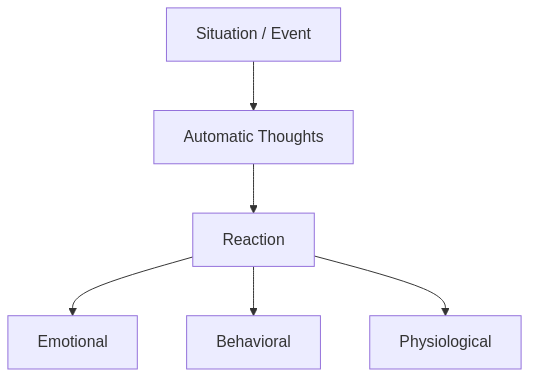
The cognitive model and automatic thoughts
A simplified conceptual cognitive model is that a situation occurs which triggers automatic thoughts which we then react to. This reaction can have emotional, behavioural, and physiological components. In other words the situation / event doesn’t directly determine how we feel or react, instead our reaction is filtered by these automatic thoughts [1]. Automatic thoughts can occur rapidly, and we may not necessarily be aware of them.
|
Tip
|
The cognitive model maintains that the situation itself isn’t causing our anxiety — rather it’s our interpretation of the situation that causes it. By using various tools, this interpretation can be altered. |
Situation: Thinks about attending a university club event
Automatic Thought: Meeting people is too hard. Everyone will think I’m weird
Emotion: Depressed, Anxious
Behaviour: Stays at home
Thinking about attending the university club event doesn’t directly make you depressed or anxious. It’s the automatic thoughts that lead to these feelings and actions. Automatic thoughts aren’t necessarily true. They are often distorted and irrational. By changing unhelpful or inaccurate thoughts, we can also change our emotions or behaviour.
Even in the case where an automatic thought is accurate, dwelling on it can still be unhelpful and lead to depression or anxiety. An example of such a thought would be "A whole semester has passed, and I still haven’t made a single friend at university". While this is true, dwelling on it will negatively impact our mood. Instead, it is better to focus on a plan to make friends moving forward.
|
Tip
|
Just because we think something doesn’t mean it is true. Also, even accurate thoughts can be unhelpful if dwelled upon excessively. |
Not only can unhelpful automatic thoughts prevent us from starting an activity, they can also cause us to quit an activity unnecessarily. The same situation can be interpreted differently depending on the individual. An event that most people would interpret as neutral can be interpreted as negative by a socially anxious person. Moreover, an event that most would interpret as slightly negative can be interpreted as catastrophic by a socially anxious person.
|
Tip
|
Distorted automatic thoughts can stop us from doing an activity we really want to do, or cause us to give up something too easily. |
Situation: Joins the university tennis club
Automatic Thought: Everyone is better than me. I should’ve started a long time ago. This is pointless. Other members have a low opinion of me because I’m not a skilled player. I’m useless at sports.
Emotion: Sadness, Anxiety, Guilt
Behaviour: Gives up tennis
Situation: Attends party
Automatic Thought: The people at the party thought I was strange. Everyone is unfriendly.
Emotion: Anxiety, Frustration
Behaviour: Escape by leaving party after 30 minutes
A more complex version of the cognitive model incorporates interactions and feedback between the different components. That is, the physiological or physical reaction can trigger additional automatic thoughts, and our emotions can influence our behaviour and so on. Ultimately, the key point is that our thoughts influence our emotions, behaviour, and physiological (physical) responses. It’s important to clearly distinguish between the different aspects: situation, thought, emotion, behaviour, and physiology.
Where do automatic thoughts come from?
Automatic thoughts come from beliefs that people have about the world around them. Some of those beliefs may be positive and others may be negative. Some are adaptive, others are dysfunctional. At times, these dysfunctional beliefs can be extreme and unrealistic and involve ideas of helplessness or worthlessness. For example, a student might believe that nobody can be trusted. By adopting beliefs that are more balanced and adaptive, ultimately future events can be interpreted in a more constructive way.
Identifying automatic thoughts
Events that occur in the physical world, as well as private mental events, can trigger automatic thoughts. Sometimes these automatic thoughts can be dysfunctional. There are a number of signs of dysfunctional automatic thoughts including:
-
They distort reality.
-
Impair reaching of goals.
-
Cause unhelpful behaviour.
-
Provoke an inappropriate emotional or physiological reaction.
Situation: Gets invited to lunch at a restaurant by a group of other students
Automatic Thought: I’m terrible at making small talk. If someone makes a joke at my expense I won’t be able to handle it.
Emotion: Stressed, Anxious
Behaviour: Decides not to attend the lunch
Automatic thoughts are often (but not always) in verbal form. They can also take the form of images or memories. For instance, you might have a vivid memory of being scolded by a teacher in front of the class. We aren’t always fully aware of them, but tend to accept them as true. In reality, they might be only partially true or not true at all. By learning to identify automatic thoughts when they occur, we can evaluate them from a realistic perspective.
In order to identify automatic thoughts when you are in an anxiety-provoking situation, or even when you think about an anxiety-provoking situation, try to think about what thoughts tend to reoccur. Focus on what you are thinking when you have a strong emotional response. These thoughts may involve what you believe the other person is thinking about you, what predictions you might be making, and what you fear might happen. Case in point, a student attending a social gathering might have the following automatic thoughts:
-
I don’t really fit in.
-
I’ll probably say something stupid.
-
Nobody really wants to talk to me.
-
Everyone can tell I’m really nervous.
-
I’m terrible at small talk.
After the gathering, they may obsess over every detail and how other attendees perceived them.
-
Other people thought I was weird and awkward.
-
I should never have gone.
-
It’s impossible for me to be comfortable in that kind of situation.
-
I said something silly.
If you still have trouble identifying automatic thoughts, there are a number of questions you could ask yourself.
-
What thought was in my head when I experienced this emotion?
-
What image or memory was in my head when I experienced this emotion?
-
What do I fear might happen?
-
What do I believe the other person is feeling / thinking about me?
-
What does this mean about my future?
Don’t worry if you have trouble at first with identifying automatic thoughts. It will become easier with practice.
|
Tip
|
Automatic thoughts can contribute to the anxiety that is felt in certain situations. We aren’t always aware of these automatic thoughts. Automatic thoughts might be untrue or only partially true. By learning to identify these automatic thoughts, we can evaluate if they are dysfunctional. |
Identifying the emotion
Moods can usually be identified with a single word. Common moods related to social anxiety that you might experience include:
-
Anxious
-
Embarrassed
-
Nervous
-
Panic
-
Scared
But at other times you might experience moods like:
-
Angry
-
Depressed
-
Frustrated
-
Irritated
-
Sad
Tracking of mood changes is central to many cognitive techniques, however, we don’t explore this in detail as this chapter is only an introduction. Please consult the books in the recommended reading section for more details.
Cognitive distortions
Automatic thoughts associated with anxiety provoking situations are often characterised by certain thinking errors termed cognitive distortions. By learning to identify these cognitive distortions, we can rebut certain unhelpful automatic thoughts and move to a more adaptive way of thinking.
Some automatic thoughts contain multiple distortions. Also, there is some overlap between the distortions. If you are having trouble categorising a thought, it is probably because it could fall under multiple categories. The key idea though is to look for distortions in your thinking and to recognise that our automatic thoughts are not facts.
Some common cognitive distortions include:
All-or-nothing thinking. Situations are viewed as only falling into two categories such as complete success or complete failure, or perfect or awful. (e.g., "I didn’t do a good job making small talk with other students at the halls of residence. Now EVERYONE thinks I’m a weirdo"). This is also called black-and-white thinking. All-or-nothing thinking is associated with unrealistic standards.
Catastrophising (fortune-telling). Consistently making negative predictions about the future, usually based on flimsy evidence (e.g., "I didn’t make any friends during the first week at university. Now I’ll never make any friends"). If the word never occurs in an automatic thought, it is often an indicator of catastrophising. A closely related cognitive distortion is catastrophic thinking, this assumes that if a negative prediction did come true, it would be terrible beyond belief.
Disqualifying or discounting the positive. Positive experiences, actions, or qualities are dismissed as not counting for various reasons. Instead, the individual focuses only on the negative (e.g., "The students at the club meeting were nice to me, but that’s only because they took pity on me. I can tell nobody likes me").
Emotional Reasoning. Because you "feel" something is true, you start to believe that it must be true. Evidence to the contrary is ignored (e.g., "I felt depressed after going to a party. That means nobody liked me"). This distortion is also called confusing feelings with facts.
Labelling. This refers to labelling yourself or others without considering evidence that might support other conclusions. Being unhappy about some specific aspect is generalised to a complete judgement about something (e.g., "I failed a test at university that means I’m a loser").
Magnification / minimisation. Negative evaluations are magnified and positive ones are minimised. You worked hard on a group project and your group got a high mark (e.g., "I didn’t do anything. A few smart people in the group deserve all the credit").
Mental Filter. This refers to filtering out positive details and focusing on one or several negative details.
Mind Reading. Making assumptions about what other people are thinking. The person you are interacting with might be thinking positive or neutral thoughts about you, but you leap to the conclusion that they are thinking negative thoughts (e.g., "In a tutorial we had to work in a group. I just know the other group members thought I was an idiot"). If the automatic thought contains the words "they think", or "they are going to think" that is often indicative of mind reading.
Overgeneralisation. This refers to making extremely broad and unjustified conclusions based on the current situation (e.g., "Two weeks have already passed at university and I haven’t made any friends. Now I’ll never make any friends").
Personalisation. The belief that others behave in a certain way due to something that you did, rather than consider other explanations or all possible factors. (e.g., "I asked the lecturer for some guidance on an assignment, but they refused saying it should be obvious. The lecturer must hate me").
Should and must statements. This refers to having fixed and inflexible ideas about how you and other people should behave. Often it involves setting standards that are so high that nobody can live up to them. If the automatic thought contains "should", "have to", "must" etc then it is probably an example of this (e.g., "I must never accidentally say the wrong thing. If I do, I’m a terrible person").
Tunnel vision. Looking at a situation solely from a negative perspective.
Unhelpful thought. Although this isn’t necessarily a distortion, we include it in our list, so we know to identify automatic thoughts that occur repeatedly that are unhelpful. (e.g., "I failed the whole semester").
|
Tip
|
Learning to identify distortions in automatic thoughts can help us talk back to these thoughts and move to a healthier, more balanced form of thinking. |
Challenging negative automatic and other maladaptive thoughts
Automatic thoughts are not facts, rather they are simply mental constructs about the way the world is. Careful examination of these constructs can reveal how accurate or inaccurate they are. Remember that social anxiety can lead us to pay attention only to information that confirms our negative thoughts. Automatic thoughts can become so familiar to us, that we never think to ask whether they make sense. Therefore, it is useful to get into the habit of questioning these automatic thoughts. Consider alternative beliefs, predictions, and interpretations. What is the evidence for the original thoughts and what is the evidence for the alternative thoughts?
One way to get a different perspective is to think about what would you tell a close friend who came to you with those thoughts following a situation they found challenging? Your friend might tell you about a party they went to and how "everybody thought they were weird and noticed that they were very anxious", you would console them and say, "I’m sure most people didn’t think you were weird. Your anxiety probably wasn’t that noticeable. Even if a few people noticed, they probably didn’t care". You might also say something like "I also feel anxious at parties, especially when I have to talk with people I don’t know. But my anxiety decreases, and then I start to enjoy myself".
|
Tip
|
If you have trouble adopting a different perspective on automatic thoughts, think about what would you tell a close friend that was having a similar thoughts? |
In addition, consider the costs and benefits of those thoughts. If those thoughts aren’t helpful, then it is time to let them go.
|
Tip
|
Let go of self-downing thoughts that aren’t beneficial. |
By correcting dysfunctional thoughts and beliefs, we experience less anxiety, less avoidance, and free up mental resources to focus on the situation at hand.
Evidence for and against an automatic thought
Often when we have automatic negative thoughts, we tend to focus on information that confirms the thought. Therefore, a useful tool is to consider the evidence for and against it. This can be done by creating a table with two columns, putting the evidence for the thought in one column and the evidence against it in another. Be careful to focus on actual facts rather than your personal interpretation. This table can then be used to create rational responses for a given distorted automatic thought.
| Evidence that supports thought | Evidence that doesn’t support thought |
|---|
Tyler was already at the beginning of his second year at university and didn’t make any new friends during the first year. He still had some friends from high school that he socialised with, but he started doubting he could make any new friends. He identified the automatic thought of "I will never make new friends at university", whenever this occurred he started to feel anxious and depressed. He created the following table to look objectively at the evidence for and against this thought.
| Evidence that supports thought. | Evidence that doesn’t support thought. |
|---|---|
I didn’t make any friends over a whole year. |
I’ve had friendly interactions with classmates. |
I’m not good at approaching people. |
People from my classes say "Hi" when they see me. |
I had trouble making friends at high school. |
I already have some acquaintances at university, just not close friends. |
I can build on the existing connections I’ve made. |
|
I’ve made friends in the past. I can do it again. |
|
There are many opportunities to make friends I haven’t explored yet. |
Tyler summarises this into the rational response "I’ve made friends before. I already have some connections I can build on. It takes time to build friendships in a new environment".
Often we accept our own automatic negative thought uncritically. In contrast, if someone at your part-time job, or who you know socially, accused you unjustly of something, you would strongly refute that accusation and provide evidence to the contrary.
|
Tip
|
Consider evidence for and against a thought. Don’t just accept a negative thought uncritically. |
Disputing questions
If you have trouble challenging your automatic thoughts, consider using the following questions to dispute them.
Do I know for certain that _____ will happen?
Am I 100 percent sure of these awful consequences?
What evidence do I have that _____?
Does _____ have to equal or lead to _____?
Do I have a crystal ball?
What is the worst that could happen? How bad is that?
Could there be any other explanations?
What is the likelihood that _____?
Is _____ really so important or consequential?
Does _____'s opinion reflect that of everyone else?
Is _____ really so important that my entire future resides with its outcome?
A Therapist's Manual for Cognitive Behavior Therapy in Groups
Start with the disputing question that seems most appropriate to the thought. If it doesn’t work, try some of the others. It’s a good idea to use several disputing questions for each automatic thought. That way you can create a comprehensive rebuttal to an unhelpful automatic thought.
|
Tip
|
Use disputing questions to challenge maladaptive automatic thoughts. |
Dealing with catastrophic thinking
A common cognitive distortion for those with social anxiety is catastrophic thinking. Recall that this distortion involves the perception that making a relatively small mistake is unimaginably bad. In reality, even if you make a small or moderate mistake, most people will have forgotten about it by the next day as they are focused on their own issues.
One way to deal with these catastrophic thoughts is to use specific disputing questions like:
-
If I did make the mistake, would it really be that bad?
-
Does it matter in the broader scheme of things?
-
Would anyone remember my mistake next week or next month?
Additionally, consider the realistic likelihood of that event occurring. A negative event usually occurs a lot less often than many socially anxious people predict. Socially anxious people are also more likely to overestimate the consequences of a negative social event. By believing a negative social event is catastrophic, individuals will feel more anxious and go to great lengths to avoid it. But in many cases, the negative social event that is feared is really no big deal.
Developing rational responses
Based on the disputing questions and other techniques mentioned in this section, it is possible to develop a set of rational responses to the automatic negative thoughts.
When developing rational responses, keep the following points in mind:
-
Take a positive or neutral point of view.
-
Keep it short.
-
Even if you don’t believe your rational response completely at first, try to keep an open mind.
-
Keep your rational response realistic.
Rational responses can dispute the original negative thought, they can also consist of attainable goals or giving yourself permission to make small mistakes that are part of normal human interactions.
Social Anxiety Thought Record
It’s useful to keep a record of your dysfunctional thoughts and more rational responses. A tool we can use for this is the social anxiety thought record. One approach is to have one thought record for each unique situation. If this is a situation we are facing for the first time, we would start a new form. It could also be a situation we have faced before, in which case we can add new material to an existing form.
It’s useful to review the record when we anticipate that a situation will reoccur, or after it has reoccurred. That way we can refresh our minds regarding how to rebut these specific negative thoughts. Although it might be difficult to develop rational responses at first, it will become easier over time.
| Anxiety-Provoking Thoughts and Predictions | Cognitive Distortions | Alternative Thoughts and Predictions |
|---|---|---|
|
Tip
|
Creating Social Anxiety Thought Records is a useful tool for combating social anxiety. Periodically reviewing these records can help keep negative thoughts in check. |
Case Study : Jasmine joining the fashion society
In this case study, we consider a university student named Jasmine who wants to join the Fashion Society. This society is for people that love fashion and want to express their individual style. In addition, it encourages ethical and sustainable practices including recycling and repurposing of clothing. One aspect of the society is doing a presentation of a look that the member created and explaining the reasoning behind it. Jasmine really wants to join, but her shyness and social anxiety starts to increase her stress levels and make her feel panicked.
How can she use a thought record to help overcome her nervousness? As an initial step as she thinks about attending the fashion society, she starts recording the automatic thoughts she is having. Next she compares the automatic thoughts to the list of cognitive distortions, and does her best to classify each automatic thought.
| Anxiety-Provoking Thoughts and Predictions | Cognitive Distortions | Alternative Thoughts and Predictions |
|---|---|---|
People won’t be friendly. Nobody will want to talk with me |
Fortune telling or Catastrophising, All-or-nothing thinking |
|
I’ll be so nervous. I won’t be able to say anything |
Fortune telling or catastrophising |
|
Everyone will already know all about fashion. I’ll end up looking stupid |
Fortune telling or catastrophising, all-or-nothing thinking, labeling |
|
I’ll be the worst dressed person there |
Fortune telling or catastrophising, labeling |
|
I have to impress everyone with my fashion choices, otherwise nobody will like me. |
Should statement, mind reading, all-or-nothing thinking |
By examining the thought record, we can see that whenever she thinks about the fashion society, her mind is filled with thoughts about the attendees being unfriendly or looking down on her because she isn’t an expert on fashion. With all these rushing through her head, it’s no surprise that she feels apprehensive about attending. If events turned out as she predicted, nobody would enjoy such an unpleasant experience
Consider a thought like "People won’t be friendly. Nobody will want to talk to me", this is a clear example of all-or-nothing thinking. Jasmine doesn’t think that one person or a few people will be unfriendly. Instead, she believes that nobody will want to talk with her. It’s also an example of fortune-telling / catastrophising, she is making a prediction about the future based on no evidence. Everyone could be friendly and eager to talk with her.
Jasmine puts a lot of pressure on herself with the thought "I have to impress everyone with my fashion choices, otherwise nobody will like me". Thinking she has to impress everyone is a good example of a should statement. She is also engages in mind-reading by thinking if she doesn’t impress someone with her fashion then they will not like her.
Overall, Jasmine has a tendency to make negative predictions about the future and to be too hard on herself by setting impossible standards. Focusing on the worst possible outcomes causes her a lot of stress and makes her less likely to want to attend the fashion society. The next step in the process is to develop effective rebuttals to these distorted thoughts.
| Anxiety-Provoking Thoughts and Predictions | Cognitive Distortions | Alternative Thoughts and Predictions |
|---|---|---|
People won’t be friendly. Nobody will want to talk with me. |
Fortune telling or catastrophising, All-or-nothing thinking |
It’s impossible to know how friendly people will be without going. Chances are most people who are attending are looking to make new friends with those who share a common interest. |
I’ll be so nervous. I won’t be able to say anything. |
Fortune telling or catastrophising |
I’ve never been so nervous before that I couldn’t say anything. There’s no evidence this will happen. All I need to do is say "hi" and make a few remarks to the other members. |
Everyone will already know all about fashion. I’ll end up looking stupid. |
Fortune telling or catastrophising, all-or-nothing thinking, labeling |
The other members are students too. How likely is it that they are all fashion experts? They are all just learning about fashion too. In the unlikely event that there are fashion experts there, why would I look stupid for not knowing as much? One of the purposes of the fashion society is sharing knowledge, so they expect people to join not knowing much. Nobody starts out as an expert. |
I’ll be the worst dressed person there. |
Fortune telling or catastrophising, labeling |
It’s unlikely I will be the worst dressed person there. But if I was, it wouldn’t matter anyway. The other people there aren’t going to be ranking people from best to worst dressed. Even suppose there was one person who was a bit judgemental - who cares? That is just one person. The other people won’t care and are likely eager to discuss fashion without judgement. |
I have to impress everyone with my fashion choices, otherwise nobody will like me. |
should statement, mind reading, all-or-nothing thinking |
Why would liking me as a person be conditional on impressing them with my fashion choices? I’ve never judged anyone as a person based on their fashion choices. Most likely the other attendees are happy to make friends with those who share a similar interest. |
After looking at each automatic thought in a rational manner, Jasmine starts to feel more relaxed about joining the fashion club and realises she was exaggerating what could go wrong. By challenging these automatic thoughts and joining the feared activity (in this case the Fashion club), Jasmine will find her anxiety reducing over time. It’s useful for Jasmine to write down the automatic thoughts and the rebuttals, so if she does feel another surge of anxiety, she can quickly review them.
As you complete more thought records, you will naturally start to consider alternative and more rational thoughts when automatic thoughts occur.
Rational and balanced thinking
It’s important to remember that the goal of these cognitive techniques is to replace distorted negative thoughts with more balanced and realistic thoughts. It’s likely that these more balanced and rationale thoughts are more positive than the original negative thought, but the goal isn’t just to replace a negative thought with a positive thought. A positive thought that is not supported by evidence could be difficult to accept and hence is unlikely to lead to a change in behaviour and emotion.
Sometimes you might find that the automatic negative thought is supported by evidence. For example, you might have an automatic negative thought that "I’m always anxious because of my part-time job". In reality, there is a lot of evidence for this because the manager is always yelling at workers and blames them unreasonably for business problems. In this case, a better approach is for the individual to come up with a plan to quit the job and find another one, rather than try to change the automatic negative thought. Not all automatic thoughts are distorted and some are best dealt with by developing an action plan.
|
Tip
|
Some automatic negative thoughts are best dealt with using strategies other than cognitive techniques — such as developing an action plan. |
Schedule activities and take action
Socially anxious people can sometimes retreat from the world and spend all their spare time watching television, playing video games, or surfing the internet. This can sap energy and cause more negative thoughts, resulting in a downward spiral of more inactivity. Therefore, it is important to take action, however small. In order not to get overwhelmed, set small goals that aren’t too difficult to achieve. Increased activity can lead to more confidence and positive thoughts which in turn then leads to more activity creating a positive feedback loop.
|
Important
|
Our mood can affect our activities, and our activities can affect our mood. |
Plan several activities that involve socialising every week. The way to improve is to make small changes in behaviour and thinking every week. Over time, these small changes build into big changes.
|
Tip
|
Start with easier social activities so as not to overwhelm yourself. |
Students will already typically have a plan for the week that incorporates things like scheduled lectures and tutorials. Social activities can be added to this same schedule.
Sometimes unhelpful thoughts can block intended activities. For example, negative predictions like "None of my classmates will be friendly if I try to strike up a conversation with them". When your mood is bad, or you are engaging in unhelpful behaviours, monitor your automatic thoughts and make note of them. Remind yourself that the automatic thoughts may be false or only partly true.
|
Tip
|
Plan for regular social activities. Even small successes can lead to improved mood and bigger changes. |
Developing coping statements
As previously mentioned, the goal of cognitive therapy isn’t relentless positivity, but rather realistic and helpful thinking. Sometimes anxiety might suddenly flare up in a situation, and it isn’t practical to go through the process of completely analysing and rebutting automatic negative thoughts and creating a rational response. In this scenario, it is useful to have some coping statements on standby. These are short statements used to reassure ourselves in a difficult situation. A given coping statement is often applicable to multiple situations.
-
It’s OK to make a mistake. Everyone does.
-
Most people won’t care that I’m a bit anxious.
-
It’s normal to feel a little awkward. Nobody is judging me.
-
If some people don’t like me, that doesn’t matter. Nobody is liked by everyone.
-
Just take one step at a time.
-
I’ve handled tough situations before, I can do it again.
-
I’ll take a couple of deep breaths and I’ll be fine. I’ve gotten through worse.
-
It doesn’t matter if I make a small mistake. People are focused on their own lives and won’t really notice.
|
Tip
|
Coping statements can be used to calm ourselves in a difficult situation without requiring a detailed analysis. |
Summary
A characteristic of social anxiety is maladaptive automatic thoughts that distort reality. This distortion, in turn, lead to disproportionate emotions, physical responses like shaking and sweating, and unhelpful behaviour, such as having to leave the situation. By analysing these automatic thoughts, we can identify particular distortions and develop a rational response. These rational responses aren’t necessarily relentlessly positive, rather they are about adopting a more balanced and objective perspective. Having an objective perspective can in turn help reduce some of the extreme emotions and "fight or flight" type response that are experienced.
As well as addressing the cognitive aspects of social anxiety, another important strategy is graduated exposure to the anxiety-provoking situation. This is covered in the next chapter.